




My Fitness Tracker Says I’m Ready to Train, but I Don’t Feel Right. Can AI or Wearable Data Actually Tell Me What I Should Do?
You wake up. Your Whoop says 88% recovered. Your Oura ring hands you an 84 Readiness. Your Garmin tells you your Body Battery is full. According to the algorithms, today is a green light.
But your legs feel heavy. Your shoulders are tight. Your coffee tastes like a chore. Something is off, and you cannot quite name it.
So which one wins, the number on your wrist or the way you actually feel?
That question comes up often in the studio, and it deserves a real answer, not a slogan.
My fitness tracker says I’m ready, but I feel exhausted. Should I still train?
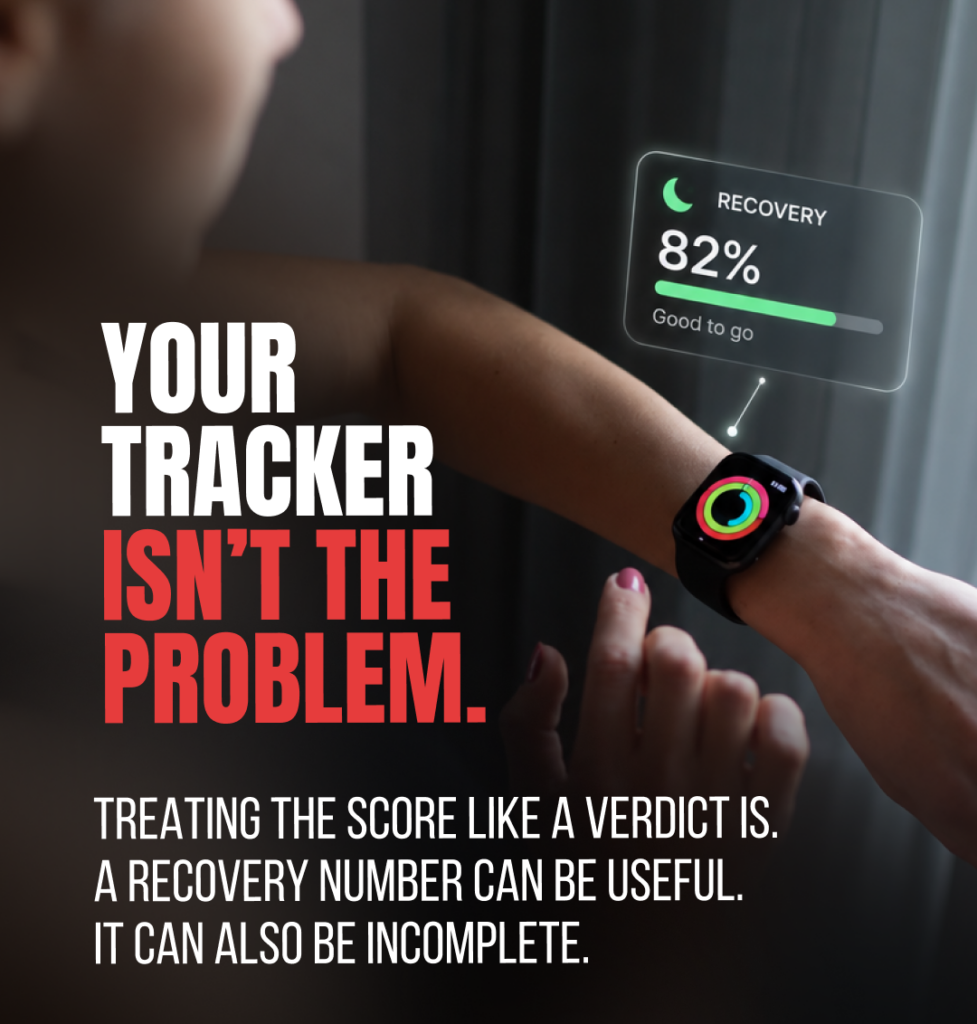
Not automatically. A green recovery or readiness score is one input, not the decision. Look at how you feel, recent sleep and training trends, symptoms, and how your warm-up responds. If those signals disagree with the device, modifying the session or recovering may make more sense than treating the score as a command.
Wearables and AI tools measure real things. What they cannot measure is all the context around a training decision. Good decisions use the data as one input among several. Interpretation is the part the device cannot do.
What does a fitness tracker actually measure?
Popular devices such as Whoop, Oura, Apple Watch, and Garmin use optical sensors to estimate physiological signals. A small sensor shines light into the skin on your wrist or finger and measures how reflected light changes as blood pulses through. That signal, called photoplethysmography, can be used to estimate heart rate, heart rate variability (HRV), respiratory rate, and blood oxygen. Some devices also incorporate skin temperature and motion.
Recovery, Readiness, Body Battery, and Sleep Score are not direct measurements. They are proprietary interpretations layered on top of raw signals, recent activity, and your personal baseline.
- Resting heart rate at night. Consumer wearables can estimate resting heart rate reasonably well under low-motion conditions, although accuracy generally decreases as movement increases.
Nocturnal HRV. In one 2025 head-to-head validation, Oura showed the strongest agreement with ECG-measured nocturnal HRV, followed by Whoop, while Garmin showed lower concordance in that specific comparison. Device performance varies by metric, model, and context
- Calories burned. Energy-expenditure estimates from consumer wearables can carry meaningful error. They are better treated as rough directional estimates than exact calorie counts.
- Signal quality. Movement, sensor placement, circulation, rhythm irregularities, device design, and skin-related optical factors can all affect photoplethysmography. The magnitude and clinical importance of those effects vary by metric and device.
So when a device hands you a single number such as 88% recovered, that number is built from multiple signals, filtered through a proprietary formula, and compressed into something that looks like a verdict.
It is not a verdict. It is a summary. And a summary is not a decision.
What does HRV mean, and should I use it to decide whether to work out?
Heart rate variability is the variation in timing between consecutive heartbeats. It reflects, in part, changes in autonomic regulation and can shift with training load, sleep, illness, alcohol, stress, hydration, travel, and other factors. Research on HRV-guided endurance training suggests it can be useful when interpreted relative to the individual and over time, but it does not function as a stand-alone answer to the question, “Should I train today?”
HRV does not explain itself. A lower morning reading could reflect training load, but it can also move with non-training stressors. That is why a single reading is usually less informative than a repeated pattern relative to your own baseline.
HRV is highly individual. Your baseline is not someone else’s baseline. The most useful comparison is usually your own trend over time, not a friend’s number or an app’s population range.
The practical version: HRV is useful context. It is not a fitness thermometer, and it does not tell you what to do by itself.
Why does my recovery score say I’m ready when I still feel tired?
The score is a summary. Readiness and Recovery scores often draw heavily on overnight physiology, recent activity, and personal baselines. They do not contain every detail of the day you are about to have or the stress that may already be building around you.
The score does not know your full history. A wearable may not know that your shoulder has been irritated for three days, that a medication recently changed, that you are in a difficult week of a training block, or that your normal schedule has been disrupted.
Different devices can disagree. Composite readiness and recovery scores are proprietary, and independent validation of their ability to predict next-day performance is still limited. Different systems can produce different interpretations from similar underlying physiology.
How you feel is still useful information. A systematic review in athlete monitoring found that self-reported measures such as fatigue, soreness, sleep, and mood were often sensitive to changes in training load and could add information that common objective markers did not capture. That research was conducted in athletes, so it should not be treated as a universal rule for every consumer wearable.
Should I skip a workout because my sleep score is low?
Not automatically. A single low sleep score is context, not a command.
Instead of letting one score make the decision, look at how you feel, whether symptoms are present, how your warm-up responds, and whether poor sleep is becoming a pattern. If the device says you slept poorly, you feel unusually flat, and your warm-up or first working set is clearly off, those signals together make a stronger case for modifying or recovering than the sleep score alone.
Can a wearable detect overtraining?
No single wearable metric independently diagnoses overtraining syndrome or non-functional overreaching.
HRV, resting heart rate, performance changes, sleep, mood, and fatigue can all contribute useful information, but overtraining is not established by one number on a wrist. Persistent symptoms or performance decline require broader interpretation and, when appropriate, medical evaluation.
Source: https://journals.lww.com/acsm-msse/Fulltext/2013/01000/Prevention,_Diagnosis,_and_Treatment_of_the.27.aspx
Can a fitness tracker tell if I’m getting sick?
Wearables can sometimes detect physiological changes that occur around illness, but signal detection is not the same as diagnosis.
Research during COVID-19 showed that wearable data could identify changes in measures such as resting heart rate around symptom onset, and in some cases before symptoms appeared. But the same types of changes can also occur with hard training, poor sleep, alcohol, travel, and other stressors.
The useful interpretation is not “my wearable says I am sick.” It is “something may be changing, and I should pay attention to the rest of the picture.”
Can ChatGPT or AI tell me what workout I should do today?
AI can organize information and generate a plan that looks reasonable. Published evaluations also show that the quality of AI-generated training advice depends heavily on the information supplied to the model.
More complete context can improve the output, but that creates an important limitation: the person prompting the tool has to know which details matter. Injury history, actual schedule, training age, symptom patterns, recent progression, and how a session unfolds in real time can all change the right decision.
AI can outline. Calibration still requires context.
How do I decide whether to train, modify my workout, or recover?
Here is a simple framework for deciding what to do when the number and your body disagree. It is not a medical decision tool. It is a practical way to organize the information you already have.
- Does my body agree with my data? If your wearable says green and you feel good, training as planned may make sense. If the device and your experience disagree, look closer before making the call.
- Is this one day, or a pattern? A single off morning is one data point. Repeated changes in sleep, fatigue, resting heart rate, HRV, soreness, or performance deserve more attention than one isolated score.
- What happens when I start moving? Your warm-up is information. If movement feels normal and effort settles where you expect it to, that is different from a session that feels unusually difficult from the first few minutes.
- Is this a red flag, not a training question? If symptoms suggest a medical issue, the decision is not “train or modify.” It is “stop and get the right professional guidance.”
- Train as planned. Body, recent trend, and session response are all reassuring, with no red flags.
- Modify. Something feels off, but there is no concerning symptom pattern. Adjust intensity, volume, exercise selection, or session length based on what you are seeing and feeling.
- Recover. A repeated pattern suggests that recovery demand is winning today. Choose an appropriate lower-load option and reassess.
- Seek professional guidance. Symptoms are concerning, persistent, recurrent, or outside normal training fatigue.
When should I stop exercising and talk to a doctor?
Some symptoms should not be managed as a coaching problem. Stop exercising and seek prompt medical attention for symptoms such as chest pain or pressure, fainting or near-fainting with exertion, severe or unusual shortness of breath, or sudden neurological symptoms such as severe headache, vision change, or focal weakness.
Sources: https://www.heart.org/en/health-topics/heart-attack/warning-signs-of-a-heart-attack
|https://www.mayoclinic.org/first-aid/first-aid-chest-pain/basics/art-20056705
Persistent unexplained fatigue, recurring palpitations, unexplained changes in resting heart rate, unintended weight loss, or symptoms that keep returning also deserve medical evaluation rather than repeated training adjustments.
No coach and no wearable should diagnose or manage those categories.
What can a personal trainer in Fairview, NC notice that my wearable or AI cannot?
A composite score cannot see the whole session. It cannot watch your movement change as fatigue accumulates, notice that a painful pattern appears only under one variation, ask a follow-up question after your warm-up, or connect today’s response with what happened in the last several weeks.
A device can send you a report in the morning. A coach can change the second set in real time.
At Specialized Fitness & Nutrition in Fairview, the useful question is not whether the wearable is “right” or “wrong.” It is how the data fits with the person, the training history, the goal, and what is happening in the room that day.
Is there a personal trainer near Asheville who can help me interpret wearable data?
If you are in Fairview, Asheville, or the surrounding Western North Carolina area and you use Whoop, Oura, Garmin, Apple Watch, or another fitness tracker, bring the data with you to a coaching conversation. The goal is not to replace the device. It is to put the numbers in context.
SFN offers a free Foundations consultation in Fairview for people who want to understand how their recent training, recovery, goals, schedule, and wearable data fit together before deciding what to do next.
Better data is useful. Better interpretation is more useful.
I am not asking you to stop wearing your Whoop, Oura, Garmin, or Apple Watch. They collect useful information, and trends over weeks and months can help you understand patterns.
What is worth reconsidering is outsourcing the decision. If the number on your wrist does not match how you feel, that disagreement is information too.
Think of the device as another input, not the deciding vote.
Book a free Foundations consultation in Fairview, NC
If any of this landed, Specialized Fitness & Nutrition offers a free Foundations consultation for people in Fairview, Asheville, and the surrounding Western North Carolina community who want a real coaching conversation before they commit to anything.
Bring your device and, if you want, the last several weeks of data. We can look at the information in the context of your training history, goals, current routine, and what you are actually experiencing.
You can reach out through the SFN website or message us directly to book.
The data is useful. The interpretation is where the training decision actually lives.
Quick answers about recovery scores, HRV, wearables, and AI
Treat it as one input, not the verdict. Symptoms, recent trends, and how the session starts matter too.
Do not let one isolated score overrule the rest of the picture. At the same time, do not ignore a repeated pattern of poor readings paired with fatigue, symptoms, or declining performance
HRV is influenced by autonomic regulation and many training and non-training stressors. It is most useful relative to your own baseline and trends.
Not automatically. A single score is context. How you feel, how the warm-up goes, whether symptoms are present, and whether poor sleep is becoming a pattern all matter.
No single wearable metric independently diagnoses overtraining syndrome. Wearables can help surface patterns worth investigating.
AI can help organize information and suggest a reasonable outline when given enough context. It cannot directly observe how you move, how a session unfolds, or which relevant details were never included in the prompt.