




The Difference Between Working Out and Training: A Fairview Coach's Honest Take
Think about this: Working out is showing up and getting tired. Training is a coached, structured plan where every session builds on the last one through technique, progression, and intent.
Most adults over 35 are working out and calling it training, which is why their effort has stopped paying off. This is an honest look at the difference, from twenty years of coaching adults in Fairview and the Asheville area.
The fitness industry celebrates effort. Your body rewards direction. Those are not the same thing, and once you see the gap between them, you cannot unsee it.
I have been coaching adults in Fairview for a long time, and the observation that has stayed with me is this: the people who work the hardest in most gyms are almost never the people getting the best results. Not because they aren’t trying. Because trying was never the whole answer, and nobody told them the other half.
The biggest lie in fitness isn’t that people don’t work hard. It’s that we’ve convinced ourselves hard work is the same thing as progress.
It isn’t. Progress is what happens when hard work is pointed at something specific. Without that, you can spend a decade in a gym and end up in almost the body you started with, and never quite understand why.
That gap has a name. Most people have never been taught it. The rest of this is about closing it.
What Is the Difference Between Working Out and Training?
In simple terms: A workout ends when you are tired. A training session ends when you did the specific thing you came to do. Working out is additive — a hundred workouts give you a hundred workouts. Training compounds, because each session was built on top of the last one.
Here is the shortest way I know to test which one you are doing. Ask yourself what you lifted last Tuesday. If you cannot answer, you are not training yet. You are visiting.
I asked that question at a consult a few years back and watched a woman in her fifties genuinely try to remember. Sharp, disciplined, eleven years into her gym life, and she had no idea. Not because she was careless. Because in eleven years, no one had ever suggested it was a question worth answering.
That is what most people mean when they say they have been strength training for years. They mean they have been showing up. Showing up matters. It is just not the thing they think it is.
Why Am I Working Out But Not Seeing Results?
Quick answer: Most people quit between weeks four and six because the mirror hasn’t changed yet. But the first month of real training isn’t building visible muscle — it is rebuilding the nervous system’s connection to the muscle you already have. Visible changes come later, on top of that foundation.
The person who quits at week five is not weak. They are reading their own patience against a body that has not shown them anything yet, and drawing the reasonable conclusion.
What no one explained is that the first four to eight weeks of real strength training are almost entirely neurological. Your brain is learning how to recruit muscle again. Research on older adults has shown people can recover close to peak strength in about eight weeks when the movement quality is coached properly. The muscle grows later, on top of that foundation.
If nobody explains this, the quiet weeks look like failure. If a coach explains it, they look like the foundation. Same weeks. Completely different story.
Why Is Personal Training More Effective Than Working Out Alone?
Quick answer: Most people quit between weeks four and six because the mirror hasn’t changed yet. But the first month of real training isn’t building visible muscle — it is rebuilding the nervous system’s connection to the muscle you already have. Visible changes come later, on top of that foundation.
There is an inch, on almost every lift, that determines whether the work does what it is supposed to. You cannot find it in a mirror. An app cannot see it. A class instructor with thirty people behind her cannot coach it. It takes a person, four feet away, watching your bar.
I have worked with members who spent ten years in commercial gyms and could not feel their own glutes fire on a hinge. Their bodies weren’t broken. The instruction had been. In a decade of gym time, nobody had ever stood next to them and moved a foot an inch. That inch is often the difference between low back pain and glute strength.
That is what coaching is. It is not motivation. It is precision.
The 2026 American College of Sports Medicine Position Stand on resistance training synthesized 137 systematic reviews and more than 30,000 participants and confirmed what any honest coach will tell you: consistency and structure drive strength, muscle, and long-term physical performance more than intensity or complexity.² The best program in the world will not fix a foot that is an inch out of place. Someone has to see it.
Why Does Working Out Stop Working After 40?
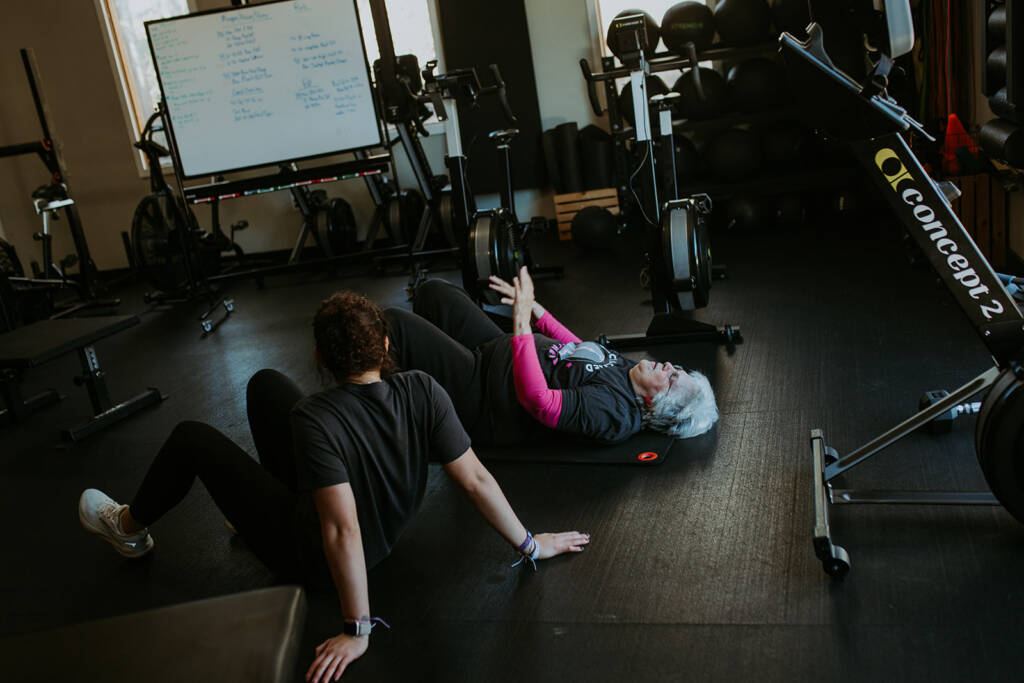
Quick answer: In your 20s, effort alone was enough to build and hold muscle. Somewhere in your late 30s, your body quietly changes the rules. Adults lose strength two to five times faster than they lose muscle mass, and the decline accelerates after 50 without a structured resistance training plan. Working harder stops working. Training smarter starts working.
The sentence I hear most often from people over 40 is some version of “It used to work, and now it doesn’t.” They are not imagining it. The routine that carried you at 32 stops paying you back at 47, and no one hands you a memo about the shift.
The CDC’s guidelines for healthy aging call for muscle-strengthening activity across all major muscle groups on at least two days a week, alongside aerobic and balance work for older adults.⁴ Read that carefully. Nothing about sweat. Nothing about soreness. Nothing about how tired you were when you left. The guideline is describing structured resistance work on a schedule. Training language, not workout language.
You cannot out-sweat aging. You can out-train it.
Progressive overload, in one paragraph: Progressive overload means gradually giving your body a little more to handle over time — one more rep, five more pounds, a cleaner bar path, a second working set. That small, deliberate increase is what forces the body to keep adapting. Without it, your training plateaus no matter how hard the session felt. It is the principle every credible strength program is built on, and it is almost impossible to apply to yourself, because you cannot see your own bar.
Why This Gym Exists in Fairview, NC
Nobody has ever walked into my gym because they wanted better squats. They came because they wanted a better life. The squats were just how we got there.
I opened Specialized Fitness & Nutrition because Fairview did not need another place to work out. It had plenty of those. What it did not have was a coached gym built for the person whose real goals never make it into fitness magazines. The one who wants to keep gardening at 75. The one who wants to hike the parkway on a Sunday. The one who wants to pick up a grandbaby without doing math about their back first.
None of those goals get met by a workout. All of them get met by coached, progressive strength training built for the real body in the room. That is the gap this gym exists to close.
Three Things I Would Tell You Standing in Front of Me
- Stop measuring soreness. Start measuring what you lifted. If you cannot remember what you did last Tuesday, you are visiting, not training. That’s not a judgment. It’s a starting point.
- Pick four movements and stay there for six weeks. A squat, a hinge, a push, a pull. Boring is where every adaptation you have ever wanted actually lives. Every time you switch programs looking for a better one, you erase the progress you were about to make.
- Ask one question about today’s session: Why that? If the answer is “because it was hard” or “because the app said so,” that was a workout. If the answer connects today to something specific six weeks from now, that was training. That question, asked honestly, is the whole difference.
The Honest Close
Training is not harder than working out. It is quieter.
It asks you to slow down when everything in you wants to push. It asks you to repeat when you want variety. It asks you to trust a plan when your gut is chasing a feeling. That trade is the whole game, and nobody I have coached into real results tells me they regret making it.
What I hear most weeks, from someone in their 50s or 60s on their first day, is a version of one sentence: I wish somebody had explained this to me twenty years ago. I can’t give those years back. I can promise the next one will look different.
If any of this sounded like you, that isn’t a coincidence. That is the pattern most adults in Fairview and the Asheville area have been quietly living inside, without ever having the language for it.
Our Free Week Offer is built for exactly this moment. A consultation, a starter training plan, and a nutrition plan built around what you actually eat, not what a magazine thinks you should. One week to feel the difference between a session that leaves you tired and a session that is going somewhere.
Frequently Asked Questions.
A workout ends when you are tired. A training session ends when you did the specific thing you came to do. Working out is additive — a hundred workouts give you a hundred workouts. Training compounds, because each session was built on top of the last one through technique, progression, and intent.
Most adults start feeling stronger in the first three to four weeks, but visible changes usually show up between weeks eight and twelve. The early weeks are the nervous system learning. The middle weeks are the muscle catching up. If you’re coached properly, the twelve-week mark is when other people start noticing before you do.
Yes, You can start at home. You cannot progress at home indefinitely. Dumbbells stop being enough somewhere between month three and month six for most adults, because progressive overload asks for load your kitchen doesn’t have. Home training works to build the habit. A gym is what lets the habit turn into results.
If you’re over 35 and can only do one, strength training is the answer. Cardio protects your heart today. Strength training protects your independence at 75. The CDC guidelines recommend both, but if time forces a choice, muscle is the tissue you lose fastest as you age, and the hardest one to get back.
No. Peer-reviewed research on adults in their 60s, 70s, and 80s consistently shows meaningful strength gains within eight to twelve weeks of coached training. The body doesn’t stop responding to strength work with age. It just stops responding to guessing. Starting later actually rewards good coaching more than starting young does.